
ELV/UNH 2Q26

~15 min read. Recommend opening in-app/browser as usual.
“Whenever I make an investment decision, I observe myself making it and think about the criteria I used... I believe that systemized, evidence-based decision making will radically improve the quality of management.” — Ray Dalio
An earnings update, keeping with our tradition having a closer eye on fresher investments. Find our last update here, and our original ELV & UNH reports here.
Note we bought a little more Elevance July 17th at $370/sh, more than our $290-345 purchases, but I feel the evidence is mounting our thesis is correct.
(I think ELV dropped as the market’s frustrated with the pace/timing of execution, but not the direction of travel. UNH was up and posted better results, mainly because it executed slightly better. However, both companies’ managements are smart, both are pulling the same levers, and both have good scale-based structural advantages, so both are navigating the industry issues. I care more about the direction vs. the pace. Whether it takes 8 or 12 quarters doesn’t matter, and we underwrote the thesis and value/IRR based on a 5+ year horizon. Meanwhile there’s now more evidence favoring our thesis. Note we previously sold some UNH at a lower price in order to source cash for our CSU bet, as we felt the bet was too large relative to a tail risk we saw in UNH, and the combined UNH+ELV bet is already large for us.)
Recall we think we’re somewhere around the nadir of this industry’s underwriting cycle. Very simply:
Nation-wide, US health insurers’ margins have compressed. Listen to any major MCO’s last 6 quarterly calls and this is the main theme.
The main issue is costs are rising faster than the insurers priced into their plans. If it’s 2025 and you are designing your 2026 insurance/benefits plans, and you think people will go to the hospital 1% more often and doctors’ wages will go up 3%, and then people go to the hospital 2% more and wages go up 4% instead, then you’ll have underpriced your insurance product and your margins will come in low. That’s the economics of insurance: you guess future loss-event costs (severity) and probability of incurring those costs (frequency/utilization), and price your contract. Since no one is prescient, insurers will periodically over- or under-estimate future costs.
This mispricing happened in 2024 & 2025, and industry margins fell. Depending on where, US healthcare costs are rising 6-11%/yr, from factors like (1) higher utilization, i.e., people going to clinics and emergency rooms more often than expected, and (2) higher unit costs, i.e., hospitals, health systems, small clinic chains, etc. raising prices more than expected.
When you are in a 5% margin business, and one expense — healthcare benefits costs — is 85% of your revenue, then being slightly wrong on this one thing means your profits fall considerably. If it goes 85% to 87% of revenue and overhead stays at 10%, then margins go from 5% to 3%, meaning profit dollars decline by 40% (=1 - 3/5). There’s little room for error in health insurance pricing.
The pain is so bad that some (usually small) insurers have closed up shop. More durable competitors are working hard with CMS — the regulator — to fix this. Until then, Elevance and UNH are losing money e.g. in Medicaid, but their fee-based commercial businesses (employer group benefits plans) are keeping them alive, because these are fee-based/administrative only, and the employer “self-insurers” and assumes the cost risk. Elevance just sells employers like IBM or John Deere access to Elevance’s discounted drug formulary and doctor clinics (their “network”), and does the payment processing, etc. That business makes money no matter what healthcare costs do, and it’s protecting our downside.
In 50 years, though health insurance has seen many changes, the cycle has always turned. In similar businesses, like automotive, real estate, and other property insurance, the cycle has always turned there, too. Always.
It is also financially unsustainable for CMS to refuse reasonable pricing & kill half the industry, nor is this in CMS’s mandate or its long-term interest. CMS is a rational regulator, based on my research, and so I think it’ll concede pricing.
So, I expect this industry to turn. The cycle has historically been short, mainly because health insurance contracts are short (usually 1 year), so a full industry cycle was often ~5 years. It’s not like oil and gas, or gold mining, where new projects take years to flood the market.
Meantime, we own the industry’s two scale leaders, (a) whose large commercial insurance businesses protect their profits, and who have industry-leading negotiating leverage over healthcare providers, which gets them lower unit costs than other insurers. This positions them to weather the storm as peers die off, until rational pricing returns to market.
Already, many ACA plans reset to much higher prices. MA rates reset via an annual bid process and many insurers already redesigned their 2026 plans for better profitability. They raised prices, reduced some healthcare plan benefits, adjusted their doctor/provider networks and negotiated better pricing, etc. CMS OK’d the prices. This will happen again in 2027 as insurers dial it in. Medicaid contracts are on a per-State basis for 3-6 year terms; here, insurers are trying to negotiate mid-contract rate adjustments with each State government (to whom CMS acts as an advisor); insurers will also walk if they can’t bid renewed contracts profitably. The remaining problem is mostly in Medicaid, since contracts are longer-term and so reprice slowly. Most recently, Elevance exited Washington D.C. Medicaid, handing off the contract.
(It doesn’t have to be the nuclear option every time, though. Each contract is bespoke, and they can negotiate to adjust the contract scope — e.g., “fine, if you will only give us 4% price instead of 5%, then we will do that but we won’t provide Medicaid coverage to XYZ sub-group of people, or exclude ABC coverage type.” There are many win-win solutions.)
The most important thing for our thesis is the industry’s ability to price in the medical cost trend and restore margins. I have a big ego and view this as logically inevitable, since even efficient and focused players in Medicaid, like Molina (MOL), aren’t even making 1% margins right now. That implies other guys, especially small ones, are losing money. ELV and UNH told us they’re still losing money, even. But, we have to check our ego and monitor the factual evidence.
So…
2Q 2026 comments from Elevance & UnitedHealth:
Medical cost trend:
ELV said benefits cost trends are no longer accelerating and the rate of growth (inflation + per-person utilization) is flat or decelerating a bit.
Medicaid margins are still going to be ~ -1.7% for the year, vs. what is normally a +2% margin business. Margins are no longer deteriorating, due to flattening cost inflation and various self-help actions I described above.
Medicare Advantage (MA) margins expected at 2% for the year, vs. what is normally a 3-5% margin business. It doesn’t seem like they re-priced sufficiently. Membership retention was higher than they thought, but still down 15% (see below). Losing unprofitable members is good, though.
ACA margins (undisclosed) are doing better given 2026 plan redesigns. Member retention was better than expected, as you’ll see below.
Commercial margins are doing OK as the vast majority of the business is fee-only. They lost one large customer in risk-based commercial, but had a strong sales year for 2026, and Commercial fee-based membership is up.
UNH said commercial plan costs are still rising 11%/yr and the company continues to take actions to keep costs in line, like narrowing its healthcare provider network, working with providers on a variety of initiatives like eliminating waste, and pushing back against aggressive pricing/billing practices. In MA, UNH expects ~3% margins and appears to have been more conservative than Elevance. They planned for 10% cost increases, which came in a little below plan, helping margins improve faster. In Medicaid, they’re still losing money and expect -1.1 to -1.7% margins this year. Both UNH and ELV are trying to renegotiate contracts. Medicaid cost trends are still elevated as well as healthier-than-average people continue exiting the insured pool after the redetermination legislation; the rate of this has slowed significantly and it’s coming to an end.
It doesn’t look like there’s any further acceleration in cost growth, which should eventually make it easy for CMS to see. CMS often looks at up to 12 month old data, so now that the trend has been consistent for longer, the regulator will be increasingly amenable to the pricing insurers want to push through.
A couple things from ELV’s membership numbers:
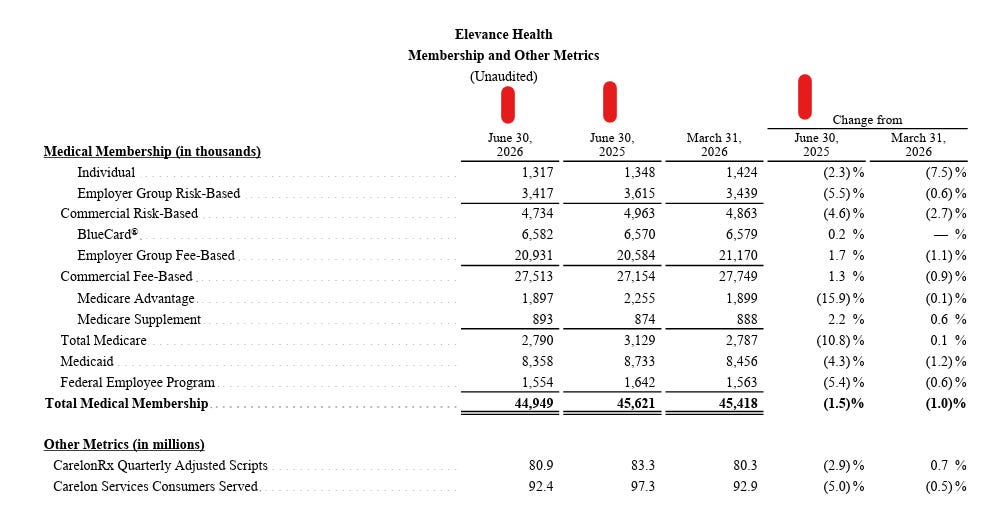
You want to look at the year-over-year compares, since the plans were re-priced and re-designed mainly for the Jan 1 2026 plan year, and remain in force for a year. So Q2 vs. Q2 is fine to look at. I quickly marked those columns with a red line.
They previously estimated the following impacts at the end of 2025:
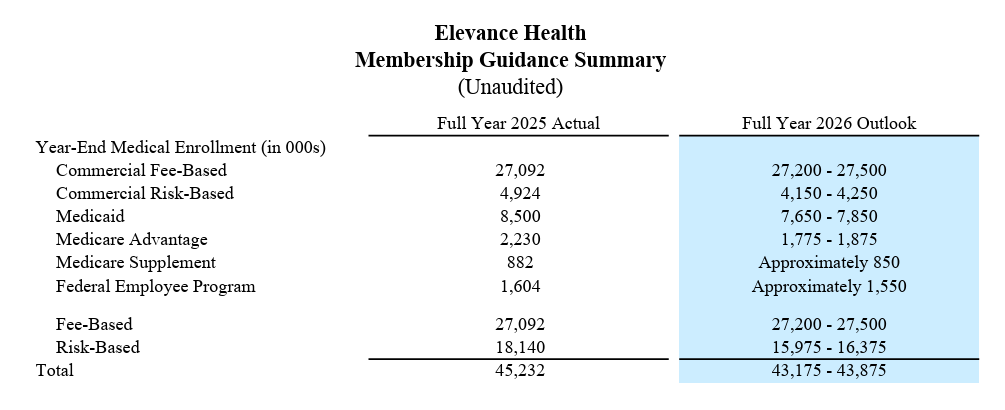
Elevance seems to be outperforming or in line with its expectations.
ACA plans: ELV doesn’t break this out, but it’s within “individual” in the first table, and “commercial risk-based” in the second table. They expected to lose a lot of ACA members and this hasn’t happened. People have mainly traded down to Bronze level plans (with less coverage) etc., in lieu of Elevance’s double-digit price increases here. The demand elasticity is less than feared.
MA: down ~15%, just above the top end of the guidance range. Some of this is due to market exits and not really demand elasticity. This may or may not come back the next 3-5 years, depending on whether ELV re-enters those markets. I was hoping it would snap back but I think I’m going to be wrong here in my volume assumptions 2+ years out. This doesn’t break the thesis, though.
Medicaid: take this with a grain of salt, but it seems to be progressing better than expected. Membership is down only 4.3% despite how much contract re-pricing and re-designing is going on.
Pricing & profitability: Despite 1.5% membership losses at ELV, concentrated in areas with high per-member revenue & profit, like MA, insurance premium revenue was +3%, implying mid-single-digit yield increases. ACA rates have already reset, MA will hopefully finish resetting in 2027-2028, and Medicaid will slowly reset over the next 3 or so years. Until then, MA margins are ~2% vs. what should be 3%+, and Medicaid is -1.75%, vs. what should be 2%+. This is holding profits down by >$2 billion/yr at ELV.
Note ELV has more Medicaid exposure, and UNH more MA exposure (as a percentage of each’s own business mix), so UNH’s profits reprice faster. I didn’t think about this when I first bought the stocks. However, we underwrote and valued each company over a 5 year horizon and will make fine money if ELV gets there more slowly.
(I’ve seen enough business model and industry problems to know that most take 3-7 years to fix, so we don’t underwrite the returns on an investment based on a 1-2 year turnaround. Sometimes it does happen, but this is not the way we bet.)
A bit on ELV’s Carelon provider business, and UNH’s Optum business.
Carelon:
Prescription volumes were down 2.9%, and consumers served were down 5%.
Carelon is currently highly integrated with ELV’s health plans. The health insurance business directs patients and policyholders to the Carelon pharmacy and clinic networks, etc. Because ELV’s membership is down, we see falling volumes here, too. It’s larger than the 1.5% total Elevance membership decline, I believe, because it’s very, very likely that these patients skew toward elderly people on MA plans. These people cost the healthcare system the most money, and so Carelon & Elevance want to have the most influence over them in order to generate the most savings. With MA membership down 15%, this is why Carelon’s volumes are down.
In my opinion, this doesn’t indicate a trend and was a one-time step-down as ELV retrenched its MA footprint. Carelon is still highly likely to grow at a strong clip for many years, and is under-penetrated within Elevance’s health plans, within other Blue Cross Blue Shield plan providers, and within the broader insurer ecosystem.
Here is one trick to see this. If you dig into the 2025 ELV 10-K, page 127, you’ll find Carelon does $72 billion revenue. Of this, $40 billion is “eliminated upon consolidation”, meaning it’s inter-company revenue that accountants have to subtract out to present the parent company’s financials. This would be services that Carelon sold to ELV’s health insurance plans: a patient with an Elevance plan (like the Wellpoint or Anthem brands) was directed to a doctor that was part of the Carelon network, and that doctor treated them and then billed the Anthem plan for reimbursement. So $40 of $72 billion was “in-house”, so to speak.
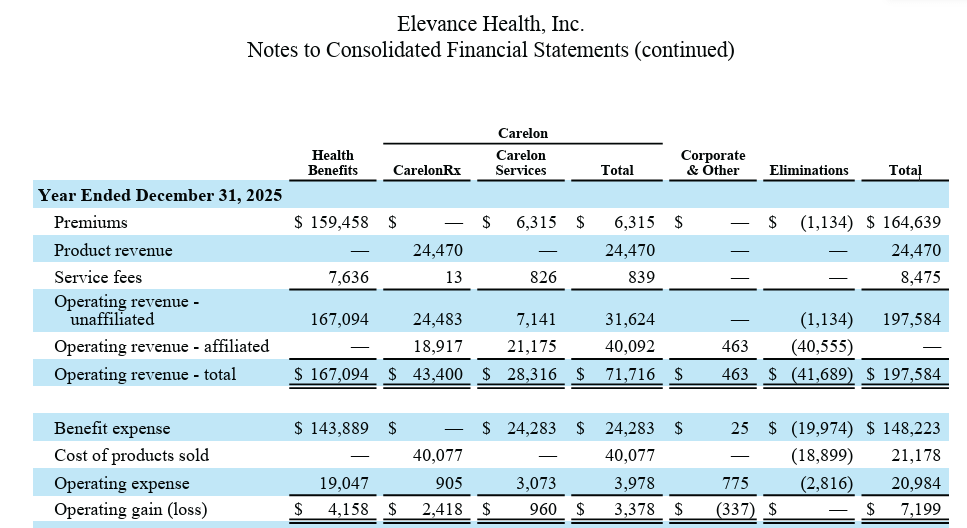
ELV’s healthcare benefits expenses — what it paid doctors and pharmacies and such — are $144 billion, meaning Carelon captures only $40/$144 = 28% of Elevance’s plan’s patient/member spend. That doesn’t make sense as a steady-state, right? Elevance’s whole goal is to use Carelon to figure out how to treat patients with high quality care but for low cost, using analytics, controlling its network and the patients’ journey, negotiating lower drug prices, etc. The more scale Carelon gets off of the Elevance member base, the better job it does at these. In turn, that makes Elevance patients better off, and improves ELV’s health plan economics. All win, and all is driven by scale. There are no other US plans with ELV’s ~45 million member scale, other than UNH (which has Optum), so no insurer but UNH stands as good a chance to build something like Carelon. You can tell Carelon is still early in the build-out for example because Optum is much older and more mature at UnitedHealth. There, if you do the same math, you find that ~60% of UNH’s benefits expense goes to Optum, vs. 28% for Carelon above. So Elevance is still mainly using non-Elevance providers for its planholders, which makes value-based care trickier today, but means an opportunity for tomorrow as it continues to vertically integrate and bring more of that in-house.
Consider also the other $32 billion of Carelon’s revenue is from other insurers, who generally have much less scale and can’t stitch these capabilities together themselves, or build this capability. But they want to benefit from it. Total US insurer plan benefits expenses — which is what gets spent at clinics, hospitals, pharmacies, etc. — are >$1 trillion. Much of that will get folded into the scale leaders’ umbrellas, Optum and Carelon, among other large “health systems” who own tons of clinics, hospitals, surgery centers, etc., like HCA Healthcare, and Kaiser Permanente in California. Such low $32/1000 = 3.2% penetration doesn’t make sense, considering the economic benefits of value-based contracting with scaled insurers and scaled providers.
Elevance is also part of the BCBS ecosystem which insurers 100 million people, or 30% of the US population, of which nearly half are directly insured by Elevance. With Carelon capturing only a few percentage points of the spend, it’s clearly under-penetrated compared to how many lives it can easily touch given Elevance’s close business relationships/ties to other BCBS-branded insurers (they share cross-state contracts and such, e.g., for when people go on vacation to a different state but end up in the hospital, and BCBS plans all share a common reimbursement card). So again, for Carelon to only be this size doesn’t make any sense. It can clearly grow its penetration within this ecosystem and become a multiple of its current size. Heck, it can double its footprint within Elevance only. It can double its footprint within the BCBS insurer group only.
Carelon’s recent volume blip is like a single wave compared to a whole tide.
Carelon’s revenue was otherwise +6.3% on higher revenues per prescription, specialty pharmacy, etc.
Optum
Optum, especially OptumHealth, the provider group, is more mature than Carelon and a lot of its business runs on value-based contracts of some kind, that are generally fixed price per-patient-per-month, where the provider is responsible for all that patient/members’ costs, everywhere. These contracts were priced assuming lower rates of cost inflation than what actually happened in 2025, so many of them were underwater. With cost inflation rates leveling off, contracts have now been repriced profitably, since they’re easier to predict.
(High + volatile inflation makes businesses difficult to run.)
Optum looks to be on a better margin track going forward now as well.
In all, our insurers are doing roughly what we outlined in the original thesis, and the thesis is progressing. We are waiting for some improvement in MA, and still a lot of improvement in Medicaid as that business swings back to profitability industry-wide.
Keeping big goals in sight
Last, I’ll mention that if you listen to every quarterly call these guys do, they highlight another 3-5 ways they are trying to improve the healthcare system, by cutting costs, improving insurer-provider relationships and workflows, improving how patients get treated and how they’re managed across multiple doctors, new contract structures that align interests between providers, patients, insurers, and government, etc. E.g., they’ll highlight some new home-based patient interaction process that helps the patient from being re-admitted to the hospital after some difficult procedure, which means 10% fewer hospital admissions from that sub-group of patients. That lack of hospital visits then saves the system money long-term and reduces the healthcare burden.
Despite the industry turmoil today, both companies have kept sight of the real goal in healthcare, and where the big win-win is: the incremental value that can be captured if they can save the system money and make it run more efficiently.
It’s the largest scale, vertically integrated insurers like ELV and UNH that are very well-positioned to do this. And they keep doing more and more of it every day with Carelon, Optum, value-based contracting, and more.
Competing hospital systems like Kaiser Permanente can try and will succeed to some degree, but they don’t have the data the insurance claims data UNH & ELV have. Other insurers lack vertical integration, so they don’t know how to provide healthcare services like ELV and UNH do because they lack the equivalents of Carelon and Optum. Our two players have a good shot at winning this pie.
— Chris